This website uses cookies so that we can provide you with the best user experience possible. Cookie information is stored in your browser and performs functions such as recognising you when you return to our website and helping our team to understand which sections of the website you find most interesting and useful.
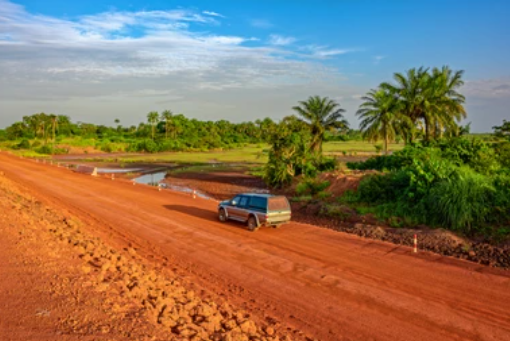
The rural commune of Lebekere, located in the Mali prefecture in Middle Guinea, is at the heart of a major ecological hotspot, with a population of 8,312. It is crossed by a biodiversity corridor crucial for the preservation of local flora and fauna. However, this ecological connectivity is currently threatened by various human pressures, including agricultural practices, natural resource exploitation, and large infrastructure projects. Among these is the paving of the road connecting Mali to Kédougou in Senegal, which could lead to increased urbanization in the area in the short term.
In this context, the Biodiversity Corridors Project in Guinea has been implemented to strengthen biodiversity conservation in territories with high ecological value. It plans to carry out pilot actions in several communes, including Lebekere. To effectively guide these interventions, conducting a socio-economic assessment is essential. This will allow for an evaluation of local living conditions, economic dynamics, resource-use practices, and the communities’ priority needs.
The assessment, carried out by Guinée 44 between May 22 and June 6, 2025, aims to demonstrate that biodiversity conservation can represent a sustainable economic opportunity for local populations. In this perspective, Alpha Oumar Barry, the field activities coordinator for the Biodiversity Corridors Project in Guinea, and Marion Cassinot played a central role in facilitating community ownership of the project and ensuring smooth operations on the ground.
Economic and social needs identified in a typical corridor village:
The report highlights a rural reality deeply marked by strong dependence on agriculture. In corridor villages, the local economy relies primarily on subsistence farming: more than three out of four people (78.2%) report agriculture as their main activity. It forms the basis of the village economic system, meeting essential food and structural needs for communities.
Agriculture is complemented by livestock farming. Although rarely the main activity (7.2%), it plays an important complementary role. More than half of households (57.6%) practice small-scale family livestock farming, including poultry, goats, or sheep, integrated with agricultural activities. This mixed model, combining food crops and domestic livestock, is the dominant form of economic organization.
However, this economy remains largely non-monetized. Cash income is limited, making households particularly vulnerable to rising monetary needs, especially for health, education, or housing improvements. In this context, many families compensate through financial transfers from the diaspora, a direct consequence of rural exodus.
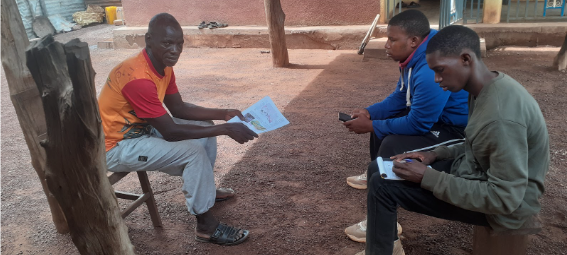
Individual survey in the Kéréwané district with a community doctor.
Groundnuts appear as the primary source of income for all households, forming the economic backbone of local farms. They generate the highest revenues, reaching up to €1,250 for some households, and remain dominant even in low-income situations. Rice, in contrast, contributes more modestly and relatively evenly to household income, ranging from €100 to €250. Its role seems more linked to diversification and food security than to high profitability.
Differences in total household income are mainly explained by contributions from other crops. Wealthier households, particularly households 2 and 5, derive a significant share of their income from this category, reflecting a more advanced diversification strategy. Diversification thus appears as a key factor for increasing income.
The analysis also reveals significant inequalities among households, with income ranging from €750 to €1,950. Household 4 stands out for its vulnerability, characterized by low income and limited diversification.
While groundnuts remain central in production systems, diversification into other crops is an essential lever to increase income and strengthen the economic resilience of farming households.
This economic fragility also translates into chronic food insecurity. Nearly 63% of households report experiencing periods of shortage, especially during the “lean season,” often described as very difficult. Food security thus remains a major concern for these populations.
Link with nature – ecosystem services and culture
At the same time, biodiversity and natural resources play a central role in the socio-economic life of the corridor. More than 75.8% of households derive direct income from ecosystem goods and services. The main resources exploited are forest fruits (53.5%). Beyond their economic value, these resources also represent a cultural heritage and a source of well-being: more than half of residents perceive biodiversity as a wealth to preserve and pass on.
However, this increased dependence on ecosystems comes with strong social and environmental pressures. Population growth, agricultural expansion, excessive wood cutting, bushfires, and poaching constitute major threats. Fires are cited as the main danger (88.2%), followed by excessive wood cutting (77.7%) and slash-and-burn agriculture (50.1%).
An economic model for the corridor
Based on these findings, the report reconstructs the typical economic model of a corridor village. It relies on subsistence agriculture based on associated crops such as rice, fonio, groundnuts, or maize. Polyculture dominates, with examples of crop associations (groundnuts-fonio) generating approximately €1,300 per year for a group cultivating two hectares. The number of members per group ranges from 11 to 95.
Family livestock serves as savings and security, providing occasional income and supplementary food. In addition, secondary income comes from the forest: gathering néré, baobab, tamarind, beekeeping, collecting medicinal plants, or producing fuelwood. These activities serve both self-consumption and small local sales.
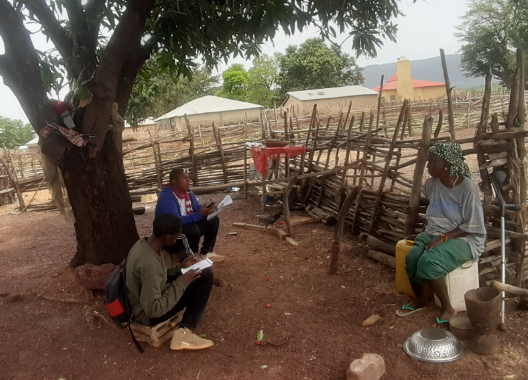
Individual survey in the Kéréwané district with a community doctor.
Integration into the formal market remains very low: trade is the main activity for only 5% of households, while salaried employment remains marginal (6.5%). Migration and remittances from migrants complement this fragile economic system.
Thus, a typical corridor village can be summarized as a vulnerable agro-ecosystem model, based on subsistence farming, complementary livestock, exploitation of natural resources, low cash income, and growing dependence on monetized needs.
Given this situation, the report emphasizes the need to promote economic activities compatible with biodiversity conservation, such as beekeeping, non-timber forest products, or ecotourism, while prioritizing productive and sustainable community investments in the long term, rather than one-off compensation measures.
Article written by Lursika d’ALMEIDA, Biodiversity Support Officer.